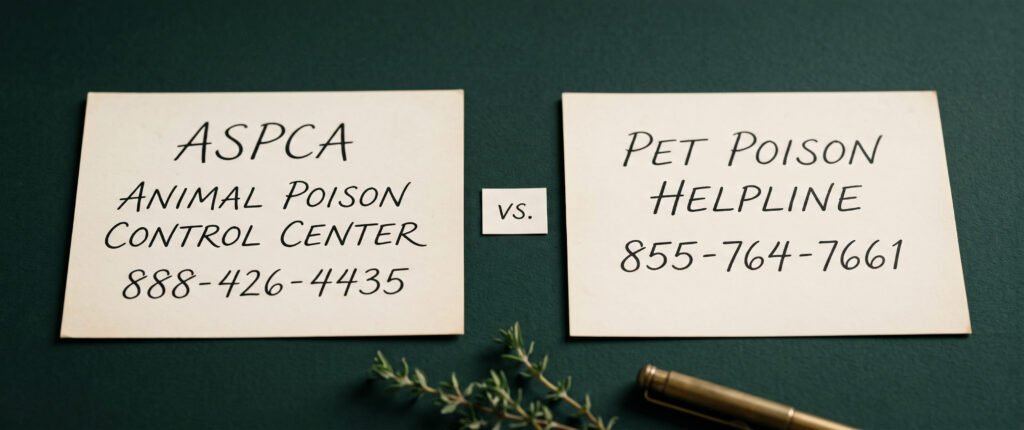
Both hotlines are open 24/7, are staffed by veterinary toxicology experts and charge a fee of about $95 to $99 per case, so in an emergency call whichever number you reach first. The biggest differences are what the fee includes and how you can contact them.
If your dog has just eaten something dangerous, don’t read on: start with our first-hour emergency steps and make the call. This page is for saving the right numbers before you need them, and for knowing what you’ll pay when you do.
Go straight to an emergency vet if your dog is having a seizure, has collapsed or is struggling to breathe, and call the clinic on the way. ASPCA Animal Poison Control: (888) 426-4435. Pet Poison Helpline: (855) 764-7661.
ASPCA vs Pet Poison Helpline at a glance
| Detail | ASPCA Animal Poison Control | Pet Poison Helpline |
|---|---|---|
| Phone | (888) 426-4435 | (855) 764-7661 |
| Hours | 24 hours a day, 365 days a year | 24/7 |
| Fee | “A consultation fee may apply,” says the ASPCA; $95 per case, according to Embrace’s June 2026 comparison | $99 per incident |
| Follow-up calls | Your vet can call back using your case number; Embrace lists follow-ups as “may cost extra” | All follow-up consultations included, for you and your vet |
| Online chat | No: its poison control page lists phone only | Yes (vets must call, not chat) |
| Who answers | Veterinary toxicology experts: more than 200 veterinary professionals, including over 50 veterinarians | Veterinarians, licensed technicians and board-certified toxicologists |
| Background | Started in 1978 as the first US animal toxicology hotline; run by the ASPCA since 1996 | Says it has over 40 years of experience and receives no public funding |
| Size | Helped more than 334,000 animals in 2025, about one call every 53 seconds | Took calls from all 50 states in 2025; 87% were about dogs |
| Payment | Fee charged per case | Credit card, by phone or through the chat payment form |
Fees and policies change, so ask about the current fee when you call.
How much does each hotline cost?
Pet Poison Helpline charges $99 per incident. Its FAQ says the one fee covers the first consultation and any follow-ups, and that “there will be no further costs regarding the case.” It explains why it charges at all: it gets no public funding.
ASPCA Animal Poison Control doesn’t publish a price on its own page. The ASPCA says only that “a consultation fee may apply.” Independent comparisons put it at $95 per case: Embrace Pet Insurance (updated June 2026, reviewed by a veterinarian), GoodRx and AAHA all give $95.
So the gap is small: about $4 at today’s prices. What matters more is follow-up. With Pet Poison Helpline, every later call about the same case is included. With the ASPCA, you get a case number your vet can use to reach the center, but Embrace’s comparison notes follow-ups may cost extra, so ask on the first call.
Is either hotline free?
No. Neither is free for pet owners. The free first call is usually your own vet during opening hours, or the nearest 24-hour emergency clinic. Many vets call a hotline themselves when they need specialist advice.
Does pet insurance cover the poison control fee?
Sometimes. AAHA notes that pet health insurance may cover much of the cost, and Embrace says its accident and illness policies cover accidental poisoning treatment, such as tests, hospital care and medicines. Check your own policy, and keep the receipt and case number.
A cheaper option if your dog is microchipped with AKC Reunite: its FAQ offers unlimited Pet Poison Helpline treatment advice as an add-on to a pet’s enrollment for a one-time $20 charge, against the helpline’s usual $99 per incident, says its offer page. You then reach the helpline by calling AKC Reunite at 800-252-7894. Add it now, not in an emergency.
What’s the same on both lines
The two hotlines work in much the same way, and either one can help with any food, plant, medicine or chemical.
- Both are open around the clock, including holidays. Holidays are exactly when dogs find chocolate, raisins and fatty leftovers like ham.
- Both are staffed by people, not chatbots. The ASPCA stresses its experts are “not AI.” Pet Poison Helpline says its staff are full-time employees.
- Both give you a case number. Your vet or emergency clinic uses it to get the full treatment plan without starting over, which saves time when your dog arrives.
- Expect the same questions: your dog’s weight, breed and age, what was eaten, how much, when, and any symptoms so far.
- Both tell you whether your dog needs a vet. Many calls end with “watch at home,” which can save a costly emergency visit. That’s the main reason a $95–$99 fee is often worth it.
Which one should you call?
In a real emergency, the best hotline is the one that answers first. If one line is busy, call the other. Here’s how to choose when you have a moment to think:
| Your situation | Best first call |
|---|---|
| Seizures, collapse, trouble breathing or unconscious | An emergency vet. Drive there and call on the way. |
| Your vet is open right now | Your vet. They can see your dog or call a hotline for you. |
| After hours, dog seems fine, you know what was eaten | Either hotline. Have the packaging and your dog’s weight ready. |
| You expect several calls about one case (watching overnight) | Pet Poison Helpline, since all follow-ups are included. |
| You can’t talk freely on the phone | Pet Poison Helpline’s online chat. |
| Your dog has the AKC Reunite poison add-on | AKC Reunite at 800-252-7894, then the helpline transfer. |
| You live in Georgia | Either hotline; Georgia service was restored in 2026 (see below). |
| You’re outside North America | Your own vet or the nearest emergency clinic. |
A note for Georgia dog owners
A Georgia law on veterinary teletriage, Senate Bill 105, took effect on July 1, 2025. AAHA reports that both hotlines then stopped giving risk assessments and treatment advice directly to Georgia pet owners, though they could still talk to your veterinarian. A follow-up law, House Bill 1195, passed both chambers without a single vote against and took effect on May 11, 2026, according to the AVMA. It makes clear that teletriage doesn’t need an existing vet-client relationship, and the Georgia Pet Coalition says it restores the hotlines’ services. If a hotline tells you it still can’t advise you directly, call your vet or an emergency clinic and ask them to contact it.
What to have ready before you call
A hotline can only judge the danger if it knows what, how much and when. Get these together while you dial, or ask someone else to:
- Your dog’s weight, even a rough one. Doses that matter are worked out per pound or kilogram.
- The packaging or label, with the ingredient list and strength. For sugar-free products, look for xylitol, which can also appear as “birch sugar.”
- How much is missing. Count wrappers, pieces or pills.
- When it happened, or the last time you saw the item intact.
- Any symptoms so far, and when they started.
For chocolate, our chocolate toxicity calculator gives you a dose estimate in seconds, so you can tell the hotline exactly what your dog ate. It doesn’t replace the call.
Don’t make your dog vomit or give any home remedy unless the vet or hotline tells you to. Our emergency guide explains why.
When a call can wait, and when it can’t
Some foods look harmless but aren’t worth gambling on. Call straight away, even if your dog seems fine, for grapes and raisins, xylitol, macadamia nuts, onions, cooked bones and dark or baking chocolate. With grapes and xylitol especially, treatment works best before signs appear.
If you’re not sure whether a food is a problem at all, look it up in our dog food checker or scan the dog food chart. If it’s marked “call a vet,” make the call. Thanksgiving is coming, so our plate-by-plate Thanksgiving guide is worth a look before the leftovers come out.
Pet poison hotlines: quick questions
Is the ASPCA poison control number free?
No. The ASPCA says a consultation fee may apply, and independent comparisons put it at $95 per case. Your own vet or emergency clinic may be able to advise you instead.
How much does Pet Poison Helpline cost?
$99 per incident, paid by credit card. The fee includes all follow-up consultations about that case, for you and your vet.
Is ASPCA or Pet Poison Helpline better?
Neither is clearly better. Both are 24/7 and staffed by veterinary toxicology experts. Pet Poison Helpline includes follow-ups and offers chat; the ASPCA runs the oldest US service, with more than 334,000 animals helped in 2025.
Why do pet poison hotlines charge a fee?
They aren’t publicly funded. Pet Poison Helpline says it couldn’t exist without the fee, and Embrace says the ASPCA’s fee pays for round-the-clock toxicology staff.
Can my vet call the hotline for me?
Yes. Both hotlines work with veterinarians. Give your vet the case number if you’ve already called, so they can get the treatment plan without paying again.
What if my dog ate something toxic but seems fine?
Call anyway. Many poisons take hours or days to show signs, and the hotline can tell you whether your dog needs to be seen or can be watched at home.
Sources
Learn how we research and review our guides. Spotted something that looks wrong? Tell us and we’ll check it against these sources.
- ASPCA. Animal Poison Control.
- ASPCA. Then and Now: How the ASPCA Protects Pets from Toxic Dangers. March 17, 2026.
- Pet Poison Helpline. Home page (fee, hours, staff).
- Pet Poison Helpline. Frequently asked questions.
- Pet Poison Helpline. 2025 Annual Report Card.
- Khuly P. Pet Poison Control: Who to Call When Your Pet Eats Something They Shouldn’t. Embrace Pet Insurance. Updated June 11, 2026.
- Lee L. Pet poisoning helplines. GoodRx. May 29, 2024.
- AAHA. Pet poison hotlines impacted by new law. Trends Magazine, 2025.
- AKC Reunite. Pet Poison Helpline FAQ and Pet Poison Helpline offer.
- Cox S. ASPCA Poison Control Hotline: When, Why, and How to Use It. Adopt a Pet. August 11, 2025.
- AVMA. State Legislative Update, May 2026 (Georgia HB 1195).
- Georgia Pet Coalition. 2026 Legislation.
This article is for general information and isn’t a substitute for advice from your veterinarian. If you think your dog has eaten something harmful, contact a vet immediately.

2 comments